

For most homeowners, a mortgage is not just something you take out once and forget. Over time, however, circumstances change — whether it’s with interest rates, your finances or long-term goals. That’s where refinancing comes in.
Refinancing means you take out a new mortgage to replace your existing loan with a new one — and often with more favorable terms. Done strategically, it can save you money, give you access to cash or allow you to pay off your home more quickly. But why do homeowners want to refinance in the first place? Let’s explore the top reasons.
Lower interest rates are among the most popular reasons to refinance. Even a little drop can go a long way.
For instance, you might save tens of thousands of dollars over the life of the loan if you press your rate down to 6 percent from 7 percent on a $300,000 mortgage.
Lower rates can mean:
You might want to refinance if your financial situation has changed — or if you simply prefer some more wiggle room in your budget — and shifting into a lower rate or extending the term of the loan can help cut down on your monthly payments.
This could be particularly useful for families with increasing outgoings, people coping with debt or homeowners looking to free up extra money each month towards savings or investments.
Others refinance to transition from a 30-year mortgage toward a 15- or 20-year one. Monthly payments are typically more expensive, but there are advantages:
This can be a smart move for individuals who have steady income and long-term financial goals.
If you originally went with an ARM because of its cheaper initial interest rate but are now a little nervous about rates increasing, consider refinancing into a fixed-rate.
Switching provides:
A cash-out refinance allows you to tap into the equity you’ve accumulated in your home. Homeowners often use this for:
It does add to your loan balance, but may be a cost-effective way to borrow compared with other forms of credit.
If you purchased your home with less than 20 percent down, there’s the chance you’re still paying PMI. After building up equity — typically 20 percent or more, though you can apply with less — a refinance may allow you to strip away this additional monthly expense.
Doing away with PMI could result in savings well into the hundreds — or even thousands of dollars — each year.
Some homeowners refinance to roll high-interest debts into their mortgage. Because mortgage rates are generally lower than those typically applied to credit cards and other personal loans, this method makes it easier to make payments while slashing overall interest costs.
But you’d have to be disciplined not to rack up new debt after refinancing.
Outside of the recoupment for debt paydown or a reno, refinancing can help with other larger life goals:
Home equity can be a valuable financial tool with the right strategy.
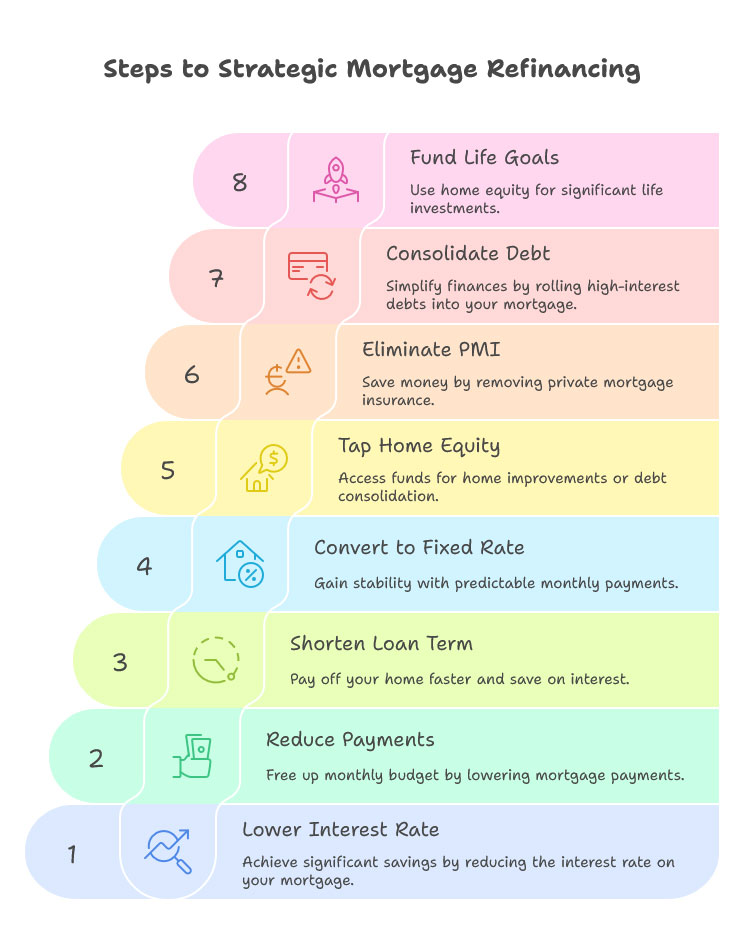
Refinancing isn’t simply about chasing after lower interest rates — it’s about tailoring your mortgage to align with your financial goals. Whether you are trying to save money, reduce your payments, build equity more quickly or tap into cash for a big expense, refinancing makes sense only if done strategically.
At Monalending, we assist home owners to determine that if it is worth for them to refinance or not. Our team will take you through your options, run the numbers and make sure that whatever decision you make is a sound one.


For many of us, purchasing a home will be the single most important investment decision we will ever…

Purchasing your first home is a big deal — but all that excitement can feel daunting if you…

For the vast majority of people, home ownership represents the single biggest purchase they’ll ever make. While you…